
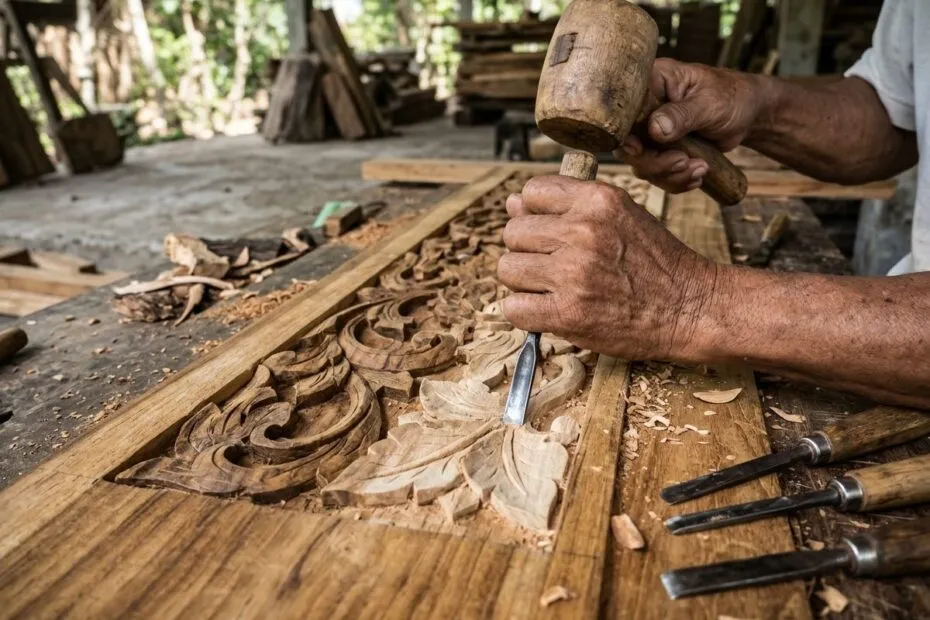
Balinese wood furniture is known for its carving: flowing leaf and tendril patterns, floral relief, and ornament borrowed from temple architecture. It is usually cut in teak or mahogany, which hold fine detail and stand up to a tropical climate. Softer local woods are used for statues, masks and decorative pieces rather than furniture.
If you are buying carved furniture from Bali, you do not need to become an expert in ornament. You do need enough of the vocabulary to describe what you want, compare quotes fairly and know what drives the cost.
This guide covers the main motifs, how Balinese carving differs from Javanese and Sumbanese work, which timbers carve well, how relief depth changes the price, and how to finish and care for carved pieces.
The Balinese ornament vocabulary
Balinese carving draws on a long tradition of temple and palace decoration. Three groups of motif come up most often.
Patra motifs. “Patra” refers to ornamental patterns, mostly based on plants. Two you will hear often:
- Patra punggel. A curling leaf and tendril pattern, with tips that spiral back on themselves. It is one of the most recognisable Balinese motifs and appears on doors, panels and frames.
- Patra cina. A floral pattern of leaves and small flowers on twining stems. The name points to Chinese influence on the style.
There are other named patra patterns. Carvers use them in combination, so a single panel may mix several.
Karang motifs. These are carved heads and faces, of guardian figures and animals, placed on temple buildings. They are protective in meaning and strongly tied to sacred architecture. They appear less on domestic furniture, and some buyers prefer to keep them that way.
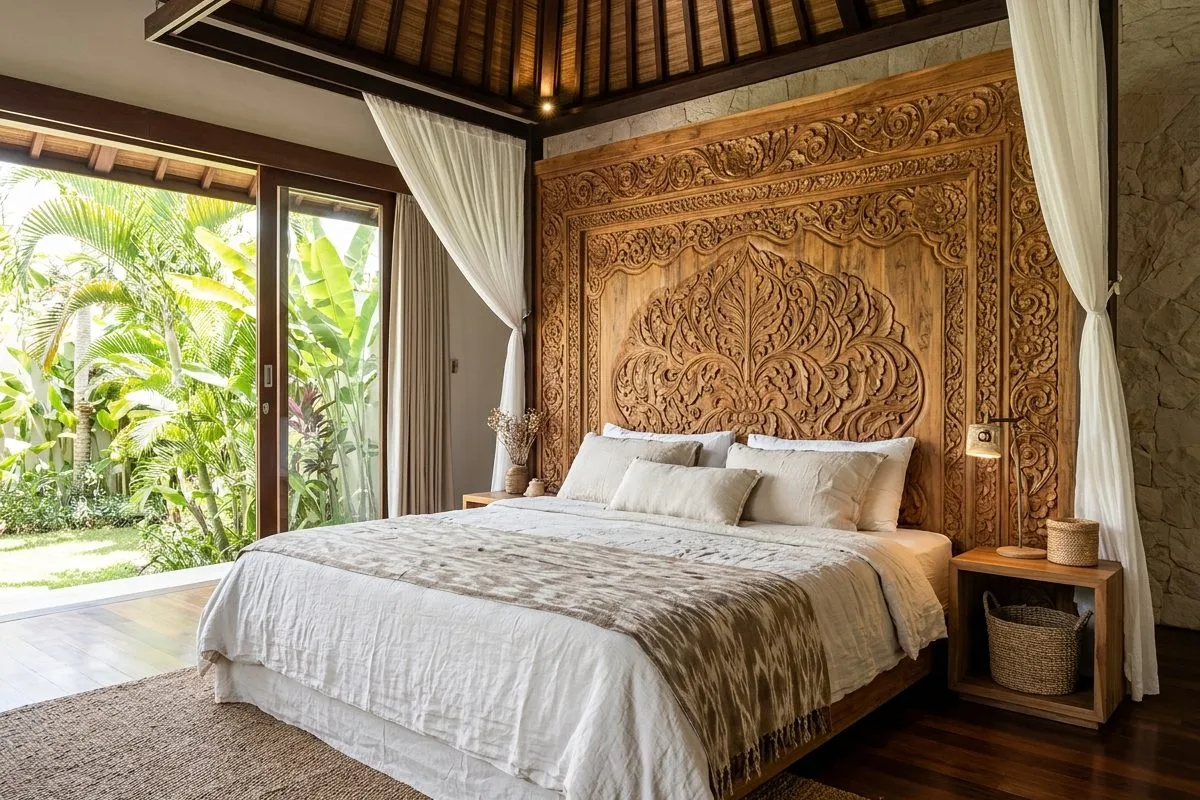
Floral relief. Lotus, frangipani and general leaf-and-flower relief appear on headboards, cabinet doors and screens. This is the most adaptable style for a modern interior, because it can be cut lightly and kept to a border or a single panel.
If you are unsure what a motif is called, send a photo. Describing the look you want, with a reference image, is more reliable than a name.
How Balinese carving compares with Javanese and Sumbanese work
Buyers in Bali see carving from across Indonesia, and the styles are easy to mix up.
Javanese carving (Jepara). Jepara, on the north coast of Central Java, is Indonesia’s best-known centre for carved teak furniture. Its work is often dense and deep, with floral and leaf patterns filling whole panels. Javanese houses also gave us the gebyok: a carved teak wall panel, often with doors set into it, used in traditional Javanese houses. We make Gebyok doors, with Sumbanese carving, and hold a large collection of antique teak doors. You can see them in our door catalogue.
Sumbanese carving. Sumba’s motifs come from the same visual language as its ikat textiles: animals, figures and symbolic shapes such as the mamuli, a traditional ornament. They tend to be bolder and more graphic than Balinese tendrils. If you like the look of Sumba ikat, our posts on styling Sumba ikat at home and the tradition of Sumbanese ikat show the source.
Balinese carving. Generally more curvilinear and lighter in feel than Jepara work, with flowing patra and floral forms, and a strong link to temple ornament.
On doors, you can choose your own carving and finishing.
Which timbers carve well
The wood decides how fine the detail can be, how long it lasts and what it costs.
Teak. The standard for carved furniture in Indonesia. It holds fine detail, its natural oils help it resist moisture and insects, and it can be used outdoors. Carved teak doors and screens last for generations. It is also the most expensive of the common furniture timbers. Our guide to teak covers grades and properties.
Mahogany. A fine, even grain that carves cleanly and takes stain well. It suits indoor carved pieces such as headboards, cabinets and mirror frames, and costs less than teak. See all about mahogany.
Suar. Suar is prized for wide slabs and dramatic grain, not for fine carving. Its grain can be irregular and tends to tear under the chisel. Use it for tabletops and live edge pieces, and pair it with carved teak or mahogany elsewhere. See all about suar.
Softer local woods. Balinese carvers use lighter, softer woods for masks, statues and decorative objects. Pule, for example, is used for masks. These woods are easier to carve in fine detail but are not suited to furniture that takes daily wear.
Relief depth and cost
Carving is priced mostly in carver’s hours. The more wood removed and the more surface covered, the higher the cost.
- Incised or shallow relief. Lines and low patterns cut a few millimetres into the surface. Quickest, lowest cost, and easiest to clean.
- Medium relief. Motifs stand clearly proud of the background. A common choice for headboards and cabinet doors.
- Deep relief. Layers of leaves and stems that overlap, with deep shadows. Much slower to cut, and needs a thicker board.
- Pierced work (fretwork). The background is cut right through, so light and air pass. Common on screens, transoms and room dividers. Slow, and more fragile than solid relief.
Two other factors move the price: coverage (a carved border costs far less than a fully carved panel) and repetition (the same panel carved ten times is more efficient than ten different designs). Our post on what custom teak furniture costs in Bali explains how the rest of a quote is built.
How carved work is finished
Carving changes how a finish behaves. Thick film finishes can pool in recesses, round off sharp edges and look plastic in deep relief. Our wood finishes guide explains why wax suits carved work: it sits thinly, keeps the detail crisp and is easy to renew.
An antique finish also suits carving well. Darker tone settles into the recesses and the raised areas read lighter, which makes the relief easier to see. White wash does something similar in a softer, paler way. We send a physical sample on the actual timber before production.
Caring for carved pieces
- Dust with a soft brush, not a cloth, which catches on edges and pushes dust into the recesses.
- Keep water out of the carving. Wipe spills quickly and avoid wet cleaning.
- Renew wax or oil when the surface looks dry, working it in with a brush.
- Watch for insect signs, such as fine powder or small holes, especially on pieces near the garden.
- Keep fretwork out of heavy traffic. Pierced panels are strong in their plane but can snap if knocked.
For general care in Bali’s humidity, see teak furniture care in a tropical climate.
Frequently asked questions
What is the best wood for carved furniture?
Teak is the usual choice for carved furniture, especially doors and anything exposed to weather. Mahogany is a good, lower-cost option for indoor carved pieces. Suar is better for slabs than for fine carving.
Why is deep carving so much more expensive?
Carving is paid for in hours. Deep relief and pierced work remove much more wood, take longer to cut cleanly and need thicker timber, so cost rises steeply with depth and coverage.
Is it appropriate to use temple motifs on home furniture?
Some motifs, such as karang heads, are closely tied to sacred architecture. Many buyers choose floral or patra designs for home furniture instead. If you are unsure, ask the maker.
How do I describe the carving I want?
Send reference photos and say where the carving goes, how much of the surface it covers and how deep it should be. That gives a maker more to work with than a motif name alone.
Choose your piece
Start with our carved and antique-style doors, the bed catalogue for carved headboards, or room dividers for screens and pierced panels. The full catalogue shows everything we make. Send a photo of the carving you like on WhatsApp to +62 812-3842-178 and we will reply within 48 hours.